December 2024
Euonymus europaeus
Common name: Spindle tree
Native to much of Europe including Britain and Ireland.
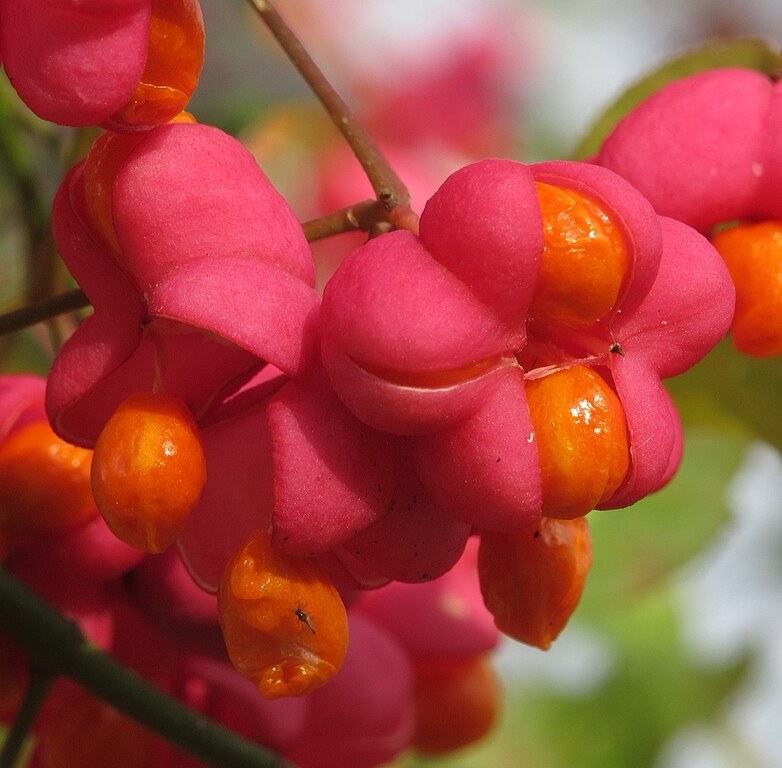
On a damp, dreary morning in early November—one of those unremarkable, grey days when a quiet melancholy rests on the air and confirms the season’s turning—I found myself stumbling through tall grass and brambles, blinded by temptation to seize a fleeting moment fully immersed beneath the arching canopy of a mature Euonymus europaeus, or Spindle tree.
With its russet autumnal leaves and branches heavy with fruit—miniature, pumpkin-shaped charms in shades of red and pink that split open to reveal vibrant orange seeds—it was a spectacle of natural artistry. A mass of fluorescent polka dots, transformed into a monochrome silhouette against the backlight, peppered the sky above me. It felt like gazing into a living artwork, reminiscent of Yayoi Kusama’s vibrant installations, but crafted by Mother Nature herself. I stood there, both mesmerized and profoundly nourished.
I have always felt lucky to come across a Spindle sapling surreptitiously naturalised in a border, especially in gardens where geologically, heavy clay presides. It is said they prefer limestone or sandy, free-draining soils and in this pocket of the High Weald, unlike Ash, Hazel and Holly, all familiar companions in my gardening experience, Spindle remains a rarity. There will always be the parent tree nearby and most probably planted with intention.
I wonder whether my sense of good fortune when coming upon one derives from a personal affinity or if I am truly attuned to some higher vibrational energy… particularly as the latin name Euonymus derives from the Greek; ‘eu’, meaning ‘good’, and ‘onoma’ meaning ‘word’. In ancient mythology the tree was considered lucky, despite its berries and leaves both being toxic to humans and some animals. One opinion suggests the name is ironic but I remain unconvinced, pondering whether its “good name” hints at something much more profound.
I guarantee anyone who stands beneath the Spindle’s canopy laden with opulence at this time of year, Thanksgiving even, will immediately see why folklore considers it a tree of good fortune in the truest sense. Its value extends beyond symbolism; this tree is a lifeline for native wildlife. Foxes, mice and birds feast on the energy-rich outer flesh of the seeds, the arils, a valuable food source at a time of year when food is in dwindling supply. Black caps, bullfinches, blackbirds and thrushes are among those that benefit. In late spring its mass of delicate white flowers offers essential nourishment for pollinators, while it also serves as a primary host for the Spindle Ermine Moth (Yponomeuta cagnagella) and invaluable sustenance for the Holly Blue caterpillar. Truly, the Spindle is more than a lucky tree— it is a haven for biodiversity.
For humans, the Spindle tree has long offered practical value. Historically the Dutch crafted the fine-grained, straight-growing wood into bobbins, needles and spindles; a testament to the tree’s strength and precision. The leaves were once used in insecticidal concoctions whilst artists have long praised its wood for producing the finest charcoal. Even the berries yield natural dyes, showcasing the tree’s versatility. With its ecological importance and array of human uses, the Spindle seems perfectly suited for a permaculture garden—a true embodiment of utility, beauty, and ecological significance.
Consider planting it as part of a hedge if nothing else as that’s also where you’ll find this tree in the countryside, growing through the hedgerows, or on the verge of woodland; the seeds scattered by the birds and small mammals. Spot it on the edge of a copse and it could even be a marker of ancient woodland. Perfect I’d say for the garden as it only grows up to 6m when left to grow untamed.
Allowing its branches to spread freely will showcase the finest display of berries, making it, in my opinion, a truly stunning specimen tree. Though understated for much of the year, its grand finale is well worth the wait. It’s especially perfect for cascading elegantly over a pond or arching gracefully above a walkway if space allows.
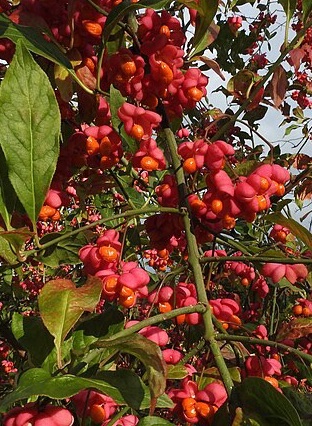
Photos by Robert Flogaus-Faust • CC BY 4.0
Online resources:
https://thedruidswell.com/2013/03/08/euonymus-spindle-tree/
 Garden Regeneration

You must be logged in to post a comment.